| Home | | | Resume | | | Gallery | | | Something about the artist | | | Printmaking 101 | | | Painting | | | Events | | | Blog | | | Guestbook | | | Mailing List | | | Links | | | Contact |
Printmaking 101
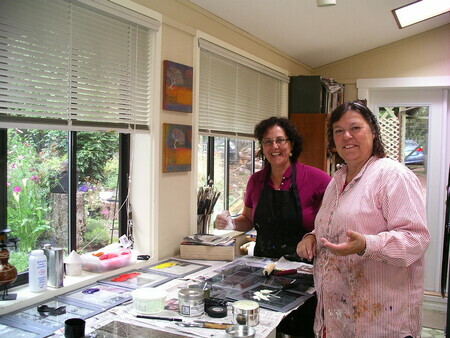
Printmaking is a passion...it is a labour of love.
In these days of rapid and easy reproduction, one might wonder why anyone would bother with printmaking anymore. I can't speak for other artists, but for myself, I LOVE the various processes I use. I also love the idea of being able to give someone an original work of art crafted by the hand of the artist for a reasonable price, and not a reproduction of a work of art.
Reproductions
The word giclee, to some printmakers, is often like waving the proverbial red flag in front of the bull. I have nothing against reproductions...it fulfills the Andy Warhol dream of art for all. For those folks who love the image but can not afford the original, it is a great way to go. It also affords the artist the ability to earn some money from their images by selling reproductions at a lower price than the one original at a high price. I have reproductions of the work of Gustav Klimt, and I love them....they are posters I bought at the museum for $20.00.
I do, however, object to them being sold as "art", and at ridiculously high prices. They are not original art, they are reproductions.
With the reproduction process, the artist is not directly involved in making the reproduction. They simply supply a jpg of their work, and the printhouse does the rest. Limited editions of jpg images, to my mind, doesn't mean much, signed by the artist or not. It means no more than telling the printer how many to print, which can be from 100 to 5000. The artist has not worked to make the copies, the camera and machine did the work.
Another practice which has cropped up in the past few years are "certificates of authenticity" which can be found on the back of the reproduction....this simply means that the artist authorized the reproduction, and not a factory somewhere in China which picked the image up from the web, and flooded the market with lots of unauthorized reproduction. It does not mean the reproduction has become authentic fine art.
Giclee is a reproduction made using an injet printer, no matter what strata it is printed on, or how it is presented or framed. Giclee with archival inks and paper can be a bit of a red herring, if it attemps to skirt the issue that it is a reproduction, and not the actual work of art. People feel they are getting something of value because it is "archival". The only value is if they love the image and want a copy of it. The giclee is not fine art. It is a reproduction of fine art. Somewhere, in that marketing, the word "reproduction" often gets left out.
One artist who advertised his prints as lithograph was shocked when I asked him where his press was. I was quite excited at the thoughts of another printmaker in the vicinity...and quite disappointed when he told me he didn't have one, but simply took his work to the commercial printer for copies, and the commercial printer told him they were lithographs. This is not a fine art lithograph, as there is no participation of the artist in the creation of the actual plates, and there are no hand pulled prints from stone or aluminum plate created by the artist. This is off set printing....a reproduction.
A legitimate print in conjunction with a printmaker is where the artist works directly on the plates, and takes part in each colour run through the press, proofing and fine tuning each step of the process. The printmaker prints the plates for the artist, and under their guidance. They work as a team. This, indeed, can be called "fine art" because of the direct involvement of the artist in the printing process.
Reproductions allow the artist to make copies of their work and sell them...and, hopefully, make a living. Especially in economically challenged times, it allows the artist to reproduce their particular image and sell them for less than the original, and pay the rent. The public has the opportunity to have an image on their wall which they love, and for a price they can afford. That is the idea behind reproductions.
The public needs to be well informed of what it is they are buying, and make their decision based on knowledge and appropriate choices for their purpose. I strongly urge people to ask about the origins of the work they are about to purchase, and how it was produced....an original print from the hands of the artist, or from a reproduction process.
Original Printmaking
As for original printmaking, it is a something created by the artist, each print being pulled from the original matrix, and with the direct involvement of the artist themselves, either on their own or with a printmaker technician to help them. There is no other way to get the look of a hand pulled print.
A hand pulled print is very tactile. There is a brilliance to the colours, the adventure of the line, and the surprise when the print is first pulled through the press...and for the printmaker, there is a thrill when the first successful print comes hot off the press that can not be duplicated in reproduction. More than one image can be pulled by the artist, depending on the process, and can be made available at an affordable price to the public, and yet each one is an original work of art.
I limit the number of prints I do of each image to 20 or 30 prints, with between 5 and 10 artist proofs, keeping the run small. I have, rarely, gone as high as 50 prints to an edition. I do not do second editions. I feel this practice preserves the integrity and value of prints which are purchased as original editions by ensuring that there are not more prints available than what is in the original run.
The following are the methods I use in my studio to create prints. There is always something new to learn and try, so the experimentation aspect of printmaking is, to me, fascinating and very absorbing. I hope you will enjoy the results.
Monoprint
Monoprints are created by working directly onto a plate with rollers, brushes, adding colours, taking away, creating lines, printing one monoprint over another, and is very spontaneous. Like painting, it demands a dialogue between the artist and the image, and the artist must be attuned to what the image is asking for as well as imposing their own ideas onto the image. Monotypes are a "one of" print, and a Monoprint is a series of monoprints that are created by working with the same elements, each slightly varied with each pull. In the case of monoprints, each one is unique, but they can run in a series. Monotypes are denoted by a 1/1 number in the lower left corner. Monoprints would be numbered according to the series.
Etchings
Etchings are created on a plate by covering the plate with a resist, drawing through the resist with a sharp needle to create lines, and then exposing the plate to an acid or salt bath. The bath eats into the metal creating a "groove" which will hold ink during the inking and printing process. The resist is then cleaned off the plate, and ink is pushed into the lines. Tarlatan or paper is used to wipe the plate of excess ink, and the wiped plate and damp paper are then run through a hand operated printing press by the artist. Tones are created by using an aquatint resist, which is a series of powder fine droplets of resist deposited on the plate and then etched to various degrees.
I use copper plates mostly, with a Ferric Chloride salt Bath. I have used aluminum plates with copper sulphate bath, but I prefer copper. The plates are inked either in one colour, or using a method called alle poupie, which means more than one colour is put on the plate and wiped for a single pull rather than multiple plates for each colour. I sometimes use chine colle in the printing process as well, which is basically collaging different papers to the print while pulling it through the press.
Stencil Prints
Stencil Prints are what they sound like...stencils are cut and inked, and layed onto the printing plate to be pulled through the press. It is a simple and fun way to work images.
Block Prints
Block prints are prints which are taken from a block of wood, linoleum or other solid surface which have been "carved" with knives to create an image. They are fun, and are inked by rolling the ink onto the block with brayers, and then printing. A press can be used, or the back of a spoon, or a barren, depending on the desired effect.
One variation is the reduction print where some of the image is cut away and the first colour is pulled, then more is cut away and a second colour is pulled, and so it continues until the plate is pretty much gone...and the last colour is pulled.
Drypoint
Drypoint is accomplished by drawing directly onto the metal plate with a diamond tipped needle. This not only cuts a groove, but also pushes up a "burr" which also catches the ink and creates a softer, blurred line. The burr, unfortunately, wears off quickly after being compressed by the press, and the image will revert to an appearance much like an etching. Therefore, drypoint does not give as many prints, unless the artist takes the plate to a metal shop and has the plate (and burr) coated in steel for strength.
Plastic plates can also be inscribed, or paper plates coated with gesso (for collograph), but these do not push up a burr, and will not give the same effect of the soft line that a true drypoint print will.
Collograph
Collograph plates are made by a process of selecting thin materials and using a glue to affix them directly onto the plate. The items must be thin to avoid unattractive buildup of ink. Relief can also be created by putting a thin coat of plaster on the plate and drawing into it, or a combination of drawing, inscribing and gluing pieces directly onto the plate. For base plates I use metal or wood, plastic or matboard. Sometimes the wood itself or whichever plate type is used lends itself to texture on the finished print. Found pieces of metal often can create fascinating textures for either a base plate or an added element. The plate is then sealed and printed.
Any of these methods can be combined, depending on the intent of the artist, and what the image is trying to convey. It is tempting and challenging to keep going on a print until it is no longer clear what it is...and then bring it back to a point of clarity. There is the learning and the mastering of the techniques, which always seems to present a new opportunity to try something, and then there is trying to use those techniques for an approach to image making which is sympathetic to the image being created. When it all comes together, it is magic...
Lithograph
Today, there are choices for lithograph. There is the traditional lithograph created on a stone which is very labour intensive, but can be quite exciting. There is lithograph created on a speciall grained aluminum plate, or using aluminum and silicone, and there is a relatively new technique using polyester plates and carbon based heat set toner. I have worked with the polyester plates, but have not mastered them. You can transfer photographs to them using a laser printer, you can draw on them with permanent inks or shrpies, or with traditional lithograph greasy pencils and tusche. If I ever master them to the degree I am satisfied with, I will put some on my website. It is, however, not my first choice of method.